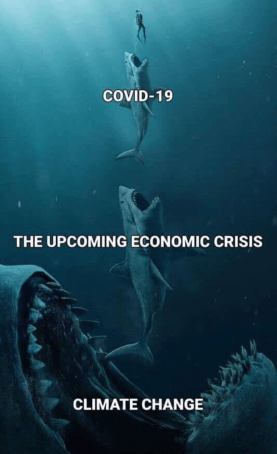
Nothing in my living memory has been as disruptive to everyday life as the measures being taken to halt the Coronavirus pandemic. And never in my life did I think would ever have any sympathy for any word uttered by Donald Trump, but maybe it’s the exception that proves the rule, when he has said: “We Can’t Have the Cure Be Worse Than the Problem”. Not that I’m advocating that we should listen to him for advice in this crisis, or that he’s managing things well in the USA, far from it! But he does address something that is awkward to talk about without crossing lines into the territory of causing widespread offence and concern. Namely that we cannot place an infinite value on human life, and that every resource allocated to COVID-19 cannot be spent elsewhere and will have long term consequences.
Importance of context
Watching and reading the news can be a very bad way to form a clear picture of the scale and impact of a crisis. Generally the media will cherry pick all of the worst examples and impacts, which we subconsciously assume is representative rather than extreme information. Also we are acutely aware of the latest crises currently being covered, but forget about those that we as a collective have become bored with. But this doesn’t stop them from raging onward behind the scenes of our attention.
According to Anna Rosling Rönnlund, author of ‘Factfulness’, very few people have a clear idea of the numbers and percentages relating to fundamental aspects of the world and economy. We are given figures on the news every day for COVID-19 deaths, but without any perspective of how many deaths normally occur with the regular flu or from other causes.
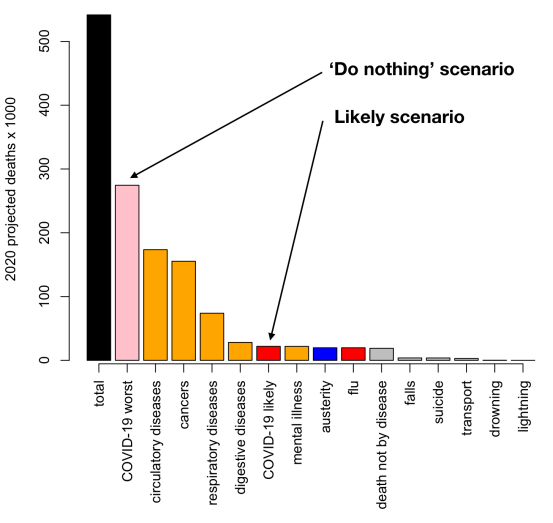
At the moment (5th April) the UK is experiencing about 600 COVID deaths per day. Estimates from the government for the duration of the crisis, given that we have implemented social distancing, was that we might expect 20,000 deaths this year, while deaths if we hadn’t taken any measures may have reached 250,000. At a more typical time there are an average of 1,600 deaths in the UK per day, or 500,000 per year. The COVID-19 death rate each day currently comprises around one third of the daily average.
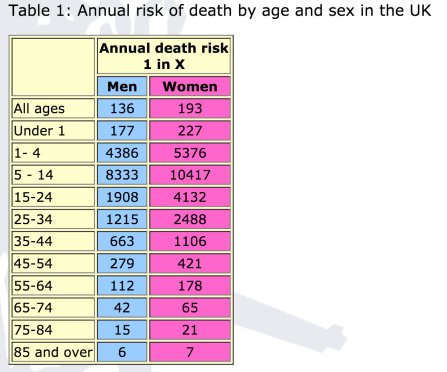
There is also a strong age effect with COVID-19 mortality risk, as there is across all types of death. If you are working age you have a roughly 999/1000 chance of surviving the next year. But if you are over 85, then there is a roughly 1 in 6 chance that you will die in a given year, even without COVID-19 in the picture. This is horrible to quantify obviously, but listening to the news you might feel that most funerals happening this week would be COVID-19-related, but not so.
Importantly I would never advocate for ‘no restrictions’ because the predicted worst case scenario of 250,000 UK deaths is horrendous, and weeks of breathing difficulties must be an awful way to go, and the trauma for NHS staff would be intolerable. The best approach is definitely to act quickly to contain this problem. The potential 250,000 death toll figure comes from worst case-scenario assumptions of no action, and on our current trajectory that is extremely unlikely, but we should use this a baseline when comparing lockdown and social distancing to the effect of doing nothing and hoping for the best.
If we assume that the virus will be well contained by our social distancing and shutdown, then we would anticipate a similar number of people will die from COVID-19 (i.e., the estimate of 20,000) versus the number killed each year by the regular flu (it varies a lot depending on strains, but the 4 year average from 2015-2018 was 18,000 per year). This is also similar to an estimate of how many people were killed due to indirect effects of austerity from 2012-2019 due to the financial crisis (131,000 total), or similar to the number of people killed by accidents, like drowning, poisoning, falls, car crashes, etc (18,000 per year).
The cost of the shutdown
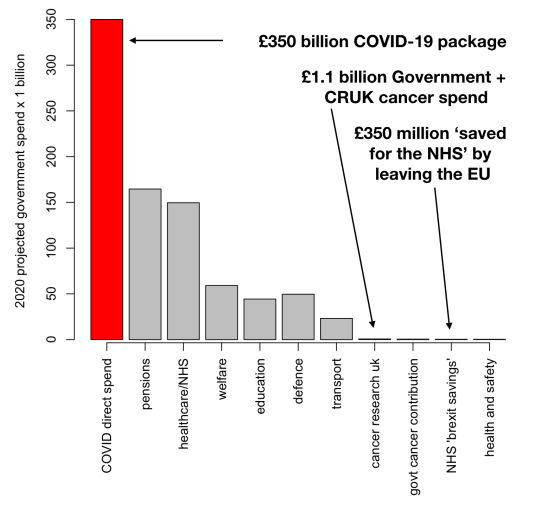
In order to alleviate and anticipate the economic fallout of the world wide shutdown the government has prepared a £350 billion package to pay wages and prop up businesses, which is only part of the price we’ll pay as an entire economy for this intervention over the years to come. If we look at the money spent in 2020 on cancer research, this is roughly 300 times less, despite that it is likely that five times more people this year (at least) will die of cancer than COVID-19. To be fair we should look at lives saved rather than lost, so the 5 year survival rate across all cancers is about 70% (so even more lives are saved than lost through treating cancer: ~150,000 deaths in the graph). Similarly we spend about £330 million per year on health and safety. While accidents cause several thousand workplace deaths annually, health and safety regulations likely save ten times more lives than this. We as a collective complain endlessly about money wasted on welfare, but £59 billion annually pales in comparison to this initial COVID-19 spend. *
The cost of a year of life
These are rough figures, but clearly there is a trend here that in monetary terms, we are valuing the prevention of deaths due to COVID-19 much higher than deaths due to other causes. Dr Malcom Kendrick, makes this point in great detail in this article. He uses a metric invented by the National Institute for Health and Care Excellence (NICE) called a QALY which represents one year at full quality of life. To make decisions on funding and healthcare, NICE values a QALY at £30,000, i.e, one year of healthy life. Importantly with COVID, it disproportionately affects older people, and the older you are the worse it is. As brutal as it sounds, the older you are, the less years of quality life you have left. The average age of death for COVID-19 in Italy seems to be about 78.5. On average COVID-19 deaths are reducing life spans by only four years. Assuming that in comparison to the no-treatment scenario we are saving 250,000 lives, then we have spent nearly £400,000 per year of quality life retained. Which by the NICE funding criteria of £30,000 per year, would never be considered as a viable tradeoff, in the context of all the other pressing problems that money could be used to address.
Further economic repercussions
The £350 billion government package isn’t the only economic burden that COVID-19 will leave in its wake. We all know people who have lost their jobs, we know small businesses that will fold, and have taken pay cuts or furlough. Freelancers and those working for cash aren’t compensated. Furthermore, an economic downturn other than causing stress and poverty, has real and fatal health consequences, with the after effects of the last financial crisis believed to have killed 131,000 so far.
Many of the staples we have come to expect, like air travel, could be affected for a long time, I have heard that commercial air travel may not normalise for up to two years. This could be great for the environment, but terrible for trade, tourism and long distance families and relationships. When something so fundamental to the economy as the aviation industry is under such pressure, how many businesses will fail, and how much economic chaos and hardship will ensue, potentially even in industries we’d not have expected? Globalisation leads to more efficient business models and more and more businesses must be operating on tight margins to compete, and cannot cushion the blow of months of lost income.
There is a lot of uncertainty in how to proceed
Many of the parameters of what we are dealing with are unknown and only becoming clearer with more time. We don’t know how many asymptomatic people there are, we don’t know the exact ways in which the disease can be transmitted, we don’t know exactly which containment strategies are worthwhile, we don’t know how the virus will mutate, whether different environments and genetic sub-strains in other countries will lead to different lethality, we don’t know how long immunity will last after recovery, and we don’t know what the effect will be of impending (hopefully) warmer weather in the northern hemisphere.
Australia has restrictions at a similar level to the UK, and may be further ‘behind’ starting their curve, but perhaps not, as the rates there seem to be plateauing. Colds and flus are generally very seasonal, because people have a superior immune system during the summer months, we spend less time indoors breathing each others’ air, and our respiratory tracts are less inflamed when air temperatures are warmer. It’s possible that despite all the social media panic about people spending too long exercising on the warmer days lately, that exercise and sunshine could be building resilience against becoming unwell. Lockdown will be associated with increased domestic violence, divorce and mental health issues. It is possible that a herd-immunity strategy may have been better for the UK in the long run, but this is a very risky approach that few would recommend because if any assumptions are wrong it could have been catastrophic.
I’m sure that governments are conducting cost-benefit analyses and strategising towards the best balance of economic protection whilst saving as many lives as possible. However, I think that the public needs to be more tolerant to the consideration of economic factors, to consider the scale of the ‘cure’ in line with the scale of the risk. We must be open to the government taking strong measures to prevent collapse, understanding tradeoffs between eventual relaxation of restrictions despite the inevitable COVID-19 risk of a second wave.
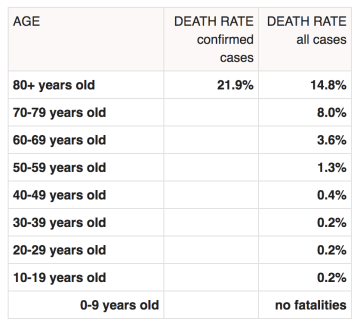
The mortality risk in this situation is very heavily skewed towards people over 65, and especially over 75, however the burden of the economic problem is very much skewed towards working age people. Something that could be considered as an interim step could be to allow employed people to work, or children to attend school, but the non working or retired population should stay in lockdown for longer, given they are the most at risk, and their continued lockdown causes the least economic damage. There could also be special dispensation for at-risk people of working age to continue isolation with state subsidy.
Failing this, we should at least sponsor an antibody test that allows those who’ve had the virus (symptomatically or not) to resume work, although this seems quite difficult to do. But strengthening the current shutdown, or maintaining the current lockdown for months and months as some commentators are suggesting, seems to be economic suicide, and wildly out of balance with the tradeoffs tolerated for other common causes of death.

 This is the world